


New academic coordinator
Prof. Dr. Christoph Safferling, Chair of Criminal Law, Criminal Procedure Law, International Criminal Law and Public International Law at Friedrich-Alexander-Universität Erlangen-Nürnberg (FAU), is the spokesperson for the steering group. He has now introduced the new academic coordinator of the project: Julius Scharnetzy, a proven expert in memorial site work. Before taking on his new role in Erlangen, he worked at the Flossenbürg concentration camp memorial for 14 years. His last position there was as head of exhibition design and communication.
Taking the city's population with him
Professor Safferling emphasized: "The founding office is now ideally positioned to drive the further development of this memorial and learning site. The implementation of the feasibility study is a serious project. We are doing everything we can to ensure that the first results become visible in the coming weeks and months. It is important for us to involve the people of Erlangen and to strive for an inclusive culture of remembrance at this site."
The new scientific coordinator Julius Scharnetzky explained: "As coordinator of the founding office, I am looking forward to working with my colleagues on the vision of an innovative and modern place of remembrance and learning. A place for Erlangen's urban society and beyond, where different people with their respective needs can learn together about the past, discuss the present and shape the future. In a place that is closely associated with the disregard for the dignity and fundamental rights of people with disabilities and mental illness, inclusion has a special meaning: both in front of and behind the scenes."
Bavaria's Interior Minister Joachim Herrmann, said: "'Euthanasia'" - with this inhumanely cynical euphemism, the Nazis trivialized a terrible crime. The truth is that they systematically seized, persecuted, deported and exterminated sick people. A clear commitment to the memory of these terrible atrocities and the memory of the victims is both a mission and an obligation for us. It is therefore clear to me that I support the planned 'HuPfla' memorial site on the grounds of the former sanatorium and nursing home in Erlangen to the best of my ability as an important place of remembrance. I am therefore delighted that the memorial and learning site is continuing to take shape and that the new founding office, with Julius Scharnetzky as the new scientific coordinator, is now fully operational."
Keeping memories alive and using them to shape the present and future
Erlangen's Lord Mayor Dr. Florian Janik said: "In the former Erlangen sanatorium and nursing home, patients were deprived of their rights during the Nazi era, they were starved to death or taken to killing centres - crimes that took place in the middle of our city. Nevertheless, this chapter was not recognized as part of our city's history for far too long. With the new memorial and learning site, we are creating a place of remembrance, research and learning that makes these crimes visible. It is our responsibility to keep the memory alive and to gain an attitude for the present and the future. And I am pleased that with the creation of the founding office, the next important step is now being taken to give shape to the memorial and learning site."
FAU President Prof. Dr. Joachim Hornegger explained: "A living culture of remembrance is of essential importance to us at FAU. This is one of the reasons why we have extensively researched the history of the Erlangen sanatorium and nursing home and the inhuman atrocities committed by the National Socialists at this location in the 'Research Project Nazi "Euthanasia" in Erlangen'. Together with the Free State of Erlangen, the University Hospital Erlangen, the City of Erlangen and the city community, we are doing everything we can to ensure that this important memorial and learning site takes shape. At this point, my thanks go above all to the steering group, headed by Prof. Dr. Christoph Safferling, who are driving this development forward with unique commitment and have also reconciled the many different perspectives."
Prof. Dr. Jürgen Winkler, representative of the University Hospital Erlangen, said: "The learning and memorial site here on our research campus is a key milestone for the University Hospital because it links the future for our scientists with the commemoration of the "euthanasia" crimes."
Concrete formats in the near future
In the further planning phase, work is already underway on the first formats and interventions. For example, the west façade of the building will be redesigned to increase the visibility of the project. The memorial and learning site will also take part in the Long Night of Science with a program of short lectures and discussions. An interim exhibition is also in the works, which will occupy parts of the building in various modules over the next few years. A workshop on the topic of inclusive remembrance culture is also currently being planned.
To the event at the memorial and learning site as part of the Long Night of the Sciences:
https://nacht-der-wissenschaften.de/2025/planung-eines-gedenk-und-lernortes-ns-euthanasie-in-erlangen
Photo: chezweitz agency
More about the memorial and place of remembrance
Shaping remembrance
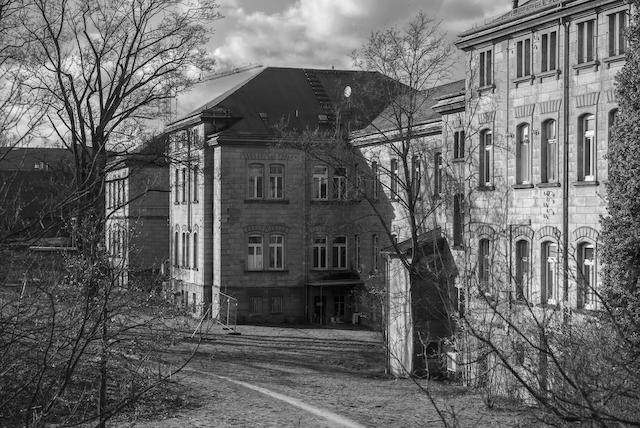
During the National Socialist era, 905 patients from the sanatorium and nursing home were murdered in the Hartheim/Linz and Pirna-Sonnenstein killing centers. In addition, a total of 1906 patients died between 1939 and 1945, at least 700 of them from "starvation diet" and structural neglect.
Shaping remembrance
During the National Socialist era, 905 patients from the sanatorium and nursing home were murdered in the Hartheim/Linz and Pirna-Sonnenstein killing centers. In addition, a total of 1906 patients died between 1939 and 1945, at least 700 of them from "starvation diet" and structural neglect.