Wichtiger Hinweis
Pedestrian Traffic Plan
Stand: 30.07.2026
Measures to promote walking are being developed for the entire city.
The goal of the pedestrian traffic plan is to increase the safety and appeal of walking throughout the entire city—both in the downtown area and in all of Erlangen’s neighborhoods. To this end, the planning framework is being developed by the commissioned planning firms “LK Argus” and “Mobilitätslösung.” The pedestrian traffic concept is being developed with the active involvement of city administration, policymakers, local experts, and the public.
Walking promotes health, reduces traffic noise and pollutants, and supports environmentally friendly mobility. For many—especially children, older adults, or people without cars—walking is often the only way to reach daycare, school, or shopping areas.
In addition to a comprehensive network plan for pedestrian traffic, the plan includes concrete measures to strengthen pedestrian traffic and promote a city of short distances.
Getting around the city on foot: healthy and eco-friendly (Photo: Canva)
Since 2024, the city has been working with external planning firms to develop a citywide pedestrian traffic plan centered on the pedestrian network. Planning is conducted on a neighborhood-by-neighborhood basis and places special emphasis on routes to school.
In the first step, key destinations were linked to residential areas. This resulted in an analysis network that was further developed through site inspections and accident analyses. The development process was accompanied by a variety of participatory formats: Pedestrian traffic assessments were conducted in five neighborhoods with city officials, advisory boards, and stakeholders. In addition, there were information booths and a mobility forum. The feedback was incorporated into the network design. For the city center and Tennenlohe, existing network concepts were updated and integrated, respectively.
The network distinguishes between three categories:
- the main network for key everyday connections
- the secondary network for other individual destinations such as elementary schools and social services, as well as
- connecting routes on the outskirts of towns and between neighborhoods.
In addition, a fourth category—so-called “strolling routes”—is being developed. These pedestrian routes are of particular importance in terms of usage and design and could be further developed, for example, as themed routes focused on health or play.
To promote walking, quality standards have been defined that apply to new planning and redesign projects. These standards pertain to
- Route design
- the public transit environment
- Quality of the public space and accessibility.
The standards are based on current legal requirements and are being implemented in phases.
The pedestrian network and these standards will form the basis for pedestrian traffic development in Erlangen for the next ten to twenty years. Improvement measures will be prioritized based on urgency and cost, with projects that can be implemented in the short term and those related to safety taking precedence. Implementation can begin following the final decision in the fall of 2026 (planned), provided that the necessary budgetary funds are available.
The Environment, Transportation, and Planning Committee has also decided to introduce a standardized approach to sidewalk parking. Sidewalk parking is permitted on 52 street segments within the pedestrian network, even though in about 92 percent of cases, the required sidewalk width of 2.50 meters is not maintained. This particularly affects children, older adults, and people with limited mobility. These issues are now being systematically addressed. As part of this effort, the city is examining how parking options can be shifted to roadways or neighborhood garages.
To mitigate the loss of parking spaces, the city is implementing an expanded parking management system with new options for residents and a more efficient use of existing spaces.
On Tuesday, November 5, 2024, a citywide kickoff event was held. The project’s goals and timeline were presented at the event.
Documentation of the Kickoff Event
In November and December 2024, interested individuals could participate in an online survey on walking in Erlangen. It was also possible to return postcards.
Documentation on online participation and the postcard survey
In the spring of 2025, during pedestrian traffic assessments in Erlangen East, Erlangen South, Sebaldus, Erlangen Bruck, Erlangen, Anger, Rathenau, and Alterlangen, citizens, policymakers, and city officials jointly evaluated the local pedestrian traffic situation. During a joint site visit and a preliminary workshop, suggestions were developed on how to make walking routes even more attractive and safer in the future. Following the site visits, the results were collectively analyzed and summarized in workshops.
The documentation is available in the download section below.
Documentation: Pedestrian Traffic Assessment for Erlangen South and Sebaldus
Documentation: Pedestrian Traffic Assessment for Erlangen East
Documentation: Pedestrian Traffic Assessment, Bruck
Documentation: Pedestrian Access Assessment for Alterlangen
Documentation: Pedestrian Access Assessment for Anger and Rathenau
The first Mobility Forum on the Pedestrian Traffic Concept took place on July 14, 2025, in the Council Chamber. Participants were briefed on the work completed to date and engaged in a joint discussion of goals and standards. The definition of the pedestrian network was also a topic of the event. A total of about 45 representatives from politics, administration, advisory boards, and interest groups participated.
You can download the presentation and documentation .
In the fall of 2025 and spring of 2026, the results of the pedestrian traffic plan were presented in the city and its districts.
As part of the 2030 Transportation Development and Mobility Plan (VEP), the City of Erlangen has identified pedestrian traffic as a key factor in the climate and transportation transition. To this end, the Committee on Environment, Transportation, and Planning passed a resolution calling for a comprehensive pedestrian traffic plan:
The following components have already been approved as part of the pedestrian traffic plan:
Galerie
More Information
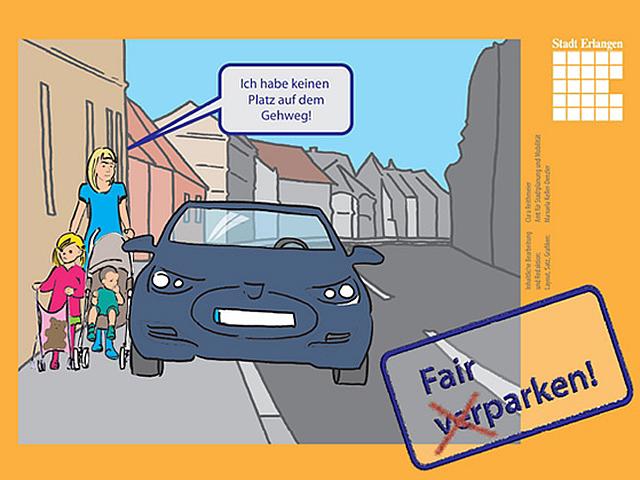
Public relations work against parking offenders - reminder cards
The distribution of reminder cards draws attention to the misconduct.
Mobility
On this page you will find an overview of all the important information about mobility and infrastructure in Erlangen.

Cycling
All information for cyclists in Erlangen: Where can I park my bike? Where are the cycle lanes? Information on funding programs and much more.
Proposals for Pedestrian Traffic
The Mobility Forum prioritizes proposals. The goal of the pedestrian traffic plan is to promote walking as an equal form of transportation.
Public relations work against parking offenders - reminder cards
The distribution of reminder cards draws attention to the misconduct.
Mobility
On this page you will find an overview of all the important information about mobility and infrastructure in Erlangen.
Cycling
All information for cyclists in Erlangen: Where can I park my bike? Where are the cycle lanes? Information on funding programs and much more.
Proposals for Pedestrian Traffic
The Mobility Forum prioritizes proposals. The goal of the pedestrian traffic plan is to promote walking as an equal form of transportation.
Mobility Planning Department
Anschrift
Öffnungszeiten
Individual appointments can also be arranged.